Weighted Scoring Model: Objective Feature Prioritization for Product Teams
Build a weighted scoring system to objectively evaluate and prioritize product features. Includes step-by-step guide, templates, and real-world examples.

Product Leader Academy
PM Education
What is a Weighted Scoring Model?
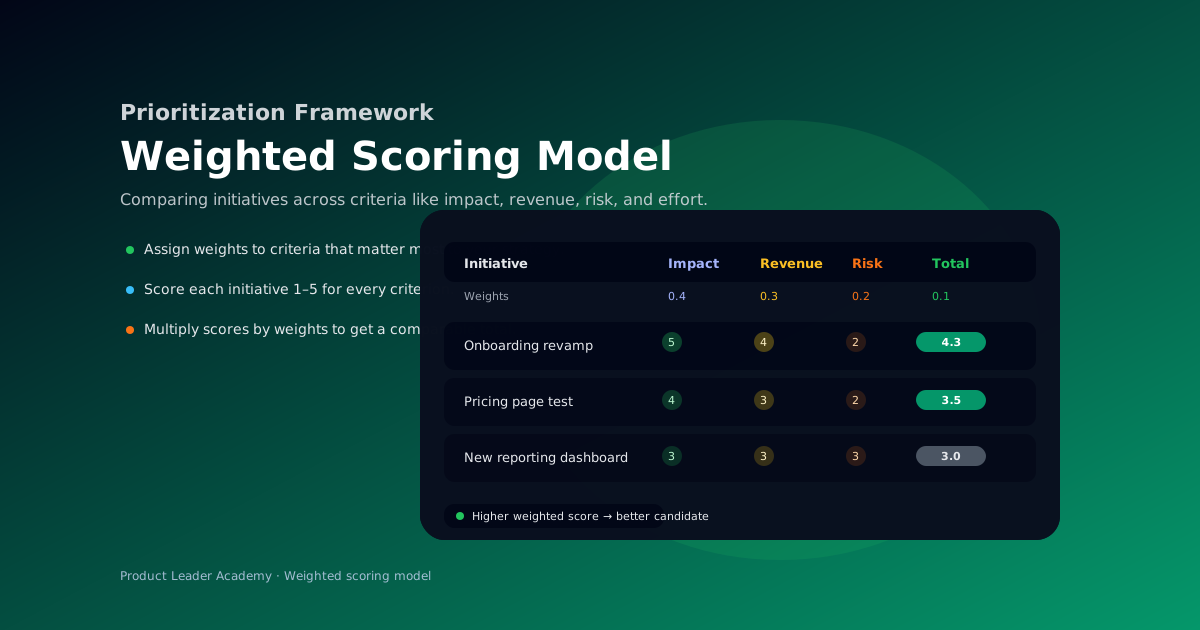
A Weighted Scoring Model is a quantitative prioritization framework that evaluates initiatives across multiple criteria, each assigned a different importance weight. It produces a single composite score for each item, enabling objective comparison and ranking.
Unlike simpler frameworks (like Value vs. Effort), weighted scoring handles multi-dimensional trade-offs—balancing revenue potential against technical risk against strategic alignment against customer demand, all in one systematic evaluation.
Why Use Weighted Scoring?
1. Objectivity
Explicit criteria and weights reduce gut-feel bias and HiPPO (Highest Paid Person's Opinion) influence.
2. Transparency
Every score is traceable to specific criteria. Stakeholders can see exactly why Feature A ranks above Feature B.
3. Flexibility
You choose the criteria and weights. The model adapts to any product context, team, or business stage.
4. Stakeholder Alignment
Agreeing on criteria and weights before scoring forces strategic alignment—often the most valuable part of the exercise.
Building Your Weighted Scoring Model
Step 1: Define Evaluation Criteria
Choose 4-7 criteria that reflect what matters to your product and business. Too few loses nuance; too many creates noise.
Common criteria for product features:
| Criteria | Description | Example Question |
|---|---|---|
| Revenue Impact | Direct or indirect revenue potential | "Will this generate measurable revenue?" |
| Customer Value | User satisfaction and retention impact | "How many users benefit and how much?" |
| Strategic Fit | Alignment with company goals and vision | "Does this advance our annual strategy?" |
| Technical Feasibility | Engineering complexity and risk | "Can we build this reliably?" |
| Time to Market | Speed of delivery | "How quickly can we ship this?" |
| Competitive Advantage | Differentiation from competitors | "Does this set us apart?" |
| Data Confidence | Quality of evidence supporting the idea | "Do we have data backing this?" |
Step 2: Assign Weights
Distribute 100 points across your criteria based on relative importance. This is where strategic priorities get encoded.
Example: Growth-Stage SaaS Product
| Criteria | Weight | Rationale |
|---|---|---|
| Revenue Impact | 25% | Primary focus on ARR growth |
| Customer Value | 25% | Retention is critical at this stage |
| Strategic Fit | 20% | Must align with Series B goals |
| Technical Feasibility | 15% | Avoid overcommitting engineering |
| Competitive Advantage | 15% | Need differentiation in crowded market |
| Total | 100% |
Example: Enterprise Product (Mature)
| Criteria | Weight | Rationale |
|---|---|---|
| Customer Value | 30% | Existing customer retention is #1 |
| Technical Feasibility | 20% | Stability matters more than speed |
| Strategic Fit | 20% | Must fit roadmap commitments |
| Revenue Impact | 15% | Incremental revenue from upsells |
| Competitive Advantage | 15% | Maintain parity, selective leads |
| Total | 100% |
Step 3: Define Scoring Scales
Create a consistent scale for each criterion. A 1-5 scale works well:
Revenue Impact:
| Score | Definition |
|---|---|
| 5 | >$500K ARR impact |
| 4 | $100K-$500K ARR |
| 3 | $25K-$100K ARR |
| 2 | <$25K ARR |
| 1 | No direct revenue impact |
Customer Value:
| Score | Definition |
|---|---|
| 5 | Critical pain point for >50% of users |
| 4 | Significant improvement for 25-50% |
| 3 | Moderate improvement for 10-25% |
| 2 | Minor improvement for <10% |
| 1 | Negligible impact |
Technical Feasibility:
| Score | Definition |
|---|---|
| 5 | Trivial — config change or minor update |
| 4 | Low complexity — one sprint, known patterns |
| 3 | Moderate — 2-4 sprints, some unknowns |
| 2 | Complex — 1-2 quarters, significant risk |
| 1 | Very complex — major architecture changes |
Step 4: Score Each Initiative
For each item in your backlog, assign a score (1-5) per criterion:
| Feature | Revenue (25%) | Customer (25%) | Strategy (20%) | Feasibility (15%) | Competitive (15%) | Weighted Score |
|---|---|---|---|---|---|---|
| Smart Notifications | 4 | 5 | 4 | 4 | 3 | 4.10 |
| API v2 | 5 | 3 | 5 | 2 | 4 | 3.90 |
| Dark Mode | 1 | 4 | 1 | 5 | 2 | 2.55 |
| Custom Reports | 4 | 4 | 3 | 3 | 5 | 3.80 |
| Mobile App | 3 | 5 | 4 | 1 | 4 | 3.45 |
Calculation for Smart Notifications:
(4 × 0.25) + (5 × 0.25) + (4 × 0.20) + (4 × 0.15) + (3 × 0.15) = 4.10
Step 5: Rank and Validate
Sort by weighted score. Then sanity-check:
- Does the top item feel right? If not, your weights may need adjustment.
- Are similar items clustered? Score ties indicate you may need finer-grained criteria.
- Did anything surprising rank high or low? Investigate—it might reveal a bias in your weights or scoring.
Advanced Techniques
Confidence-Adjusted Scoring
Multiply each score by your confidence level (0.5-1.0):
Adjusted Score = Raw Score × Confidence
This penalizes ideas where you're guessing and rewards ideas backed by data.
Negative Criteria (Cost/Risk)
Some criteria should reduce the score. Handle this by inverting the scale:
- Technical Risk: 5 = Very risky (bad), 1 = No risk (good)
- Use a negative weight: -10%
Or score inversely: 5 = Low risk, 1 = High risk with a positive weight.
Threshold Filters
Before scoring, apply mandatory thresholds:
- Must align with at least one OKR
- Must be technically feasible within the quarter
- Must not require more than 2 team dependencies
Items failing thresholds are eliminated before scoring begins.
Running a Scoring Session
Preparation (30 min before)
- Share the scoring model (criteria, weights, scales) with participants
- List the 10-20 items to evaluate
- Gather supporting data (analytics, feedback, estimates)
Session Format (90-120 min)
-
Align on criteria and weights (15 min) Review and confirm. Adjust weights if priorities have shifted.
-
Individual scoring (20 min) Each participant scores all items independently. This prevents anchoring bias.
-
Reveal and discuss (40-60 min) Show averaged scores. Focus discussion on items with high variance—these reveal disagreements worth resolving.
-
Finalize (15 min) Lock in scores. Document rationale for controversial items.
-
Rank and commit (10 min) Sort by score. Confirm the top items match capacity.
Best Practices
1. Revisit Weights Quarterly
Business priorities shift. Update weights when strategy changes.
2. Use Relative Scoring
Don't agonize over absolute scores. The goal is relative ranking—"Is A higher than B?"
3. Separate Scoring from Advocacy
The person who proposed an idea shouldn't score it. Use blind scoring or averages from multiple scorers.
4. Document Everything
Record scores, weights, and rationale. Future-you will thank present-you when revisiting decisions.
5. Combine with Other Frameworks
Use weighted scoring for quarterly planning, then Value vs. Effort for sprint-level decisions within the prioritized set.
Common Mistakes
- Too many criteria — More than 7 creates scoring fatigue and diminishing returns
- Equal weights — If everything weighs the same, why use weights? Be opinionated.
- Gaming scores — Stakeholders inflating scores for pet projects. Use independent scoring + discussion.
- One-time exercise — Scoring is a recurring discipline, not a one-off event
- Ignoring the discussion — The conversations during scoring are often more valuable than the final numbers
Weighted Scoring vs Other Frameworks
| Aspect | Weighted Scoring | RICE | Value vs Effort | MoSCoW |
|---|---|---|---|---|
| Criteria | Custom (4-7) | Fixed (4) | Fixed (2) | Fixed (4 categories) |
| Quantitative | Yes | Yes | Semi | No |
| Customizable | Highly | Limited | Limited | No |
| Speed | Medium (2 hrs) | Medium (2 hrs) | Fast (30 min) | Fast (1 hr) |
| Best for | Multi-criteria decisions | Backlog ranking | Quick prioritization | Requirements triage |
Template
Weighted Scoring Spreadsheet
| Initiative | [Criteria 1] | [Criteria 2] | [Criteria 3] | ... | Weighted Score |
|            | Weight: __% | Weight: __% | Weight: __% | ... |                |
|------------|-------------|-------------|-------------|-----|----------------|
| Feature A  | [1-5]       | [1-5]       | [1-5]       | ... | [calculated]   |
| Feature B  | [1-5]       | [1-5]       | [1-5]       | ... | [calculated]   |
Decision Record
Date: [Date]
Participants: [Names]
Criteria & Weights: [List]
Top 5 Priorities:
1. [Feature] — Score: [X.XX] — Rationale: [Why]
2. ...

Deferred Items:
- [Feature] — Score: [X.XX] — Reason deferred: [Why]
Conclusion
The Weighted Scoring Model brings rigor to prioritization without sacrificing flexibility. By making criteria and weights explicit, it turns subjective debates into structured decisions.
The real power isn't in the final scores—it's in the conversation about what criteria matter and how much. That alignment is worth more than any spreadsheet.
Start with 4-5 criteria that match your current strategic priorities, score your top 15-20 initiatives, and let the numbers guide (not dictate) your roadmap.
Want to build and practice weighted scoring with real product scenarios? Join Product Leader Academy for hands-on prioritization workshops.
Tags
Related Articles

The Scope Expansion Audit: How PMs Map and Tame Scope Creep
Learn how to use the Scope Expansion Audit (SEA) to map dependencies, evaluate value-to-complexity, and manage scope creep without burning developer bridges.

MoSCoW Prioritization: The Complete Guide for Product Managers
Learn how to use the MoSCoW method to prioritize product features and requirements effectively. Includes examples, templates, and best practices.

RICE Scoring: A Data-Driven Approach to Product Prioritization
Master the RICE scoring framework used by Intercom and top product teams. Learn to calculate Reach, Impact, Confidence, and Effort for better prioritization.