The Trust-First AI Strategy: Why Reliability is Your New Competitive Moat
Shift from AI hype to trust. Discover the three pillars of a Trust-First AI Strategy to overcome skepticism, ensure data privacy, and drive user retention.

Product Leader Academy
PM Education
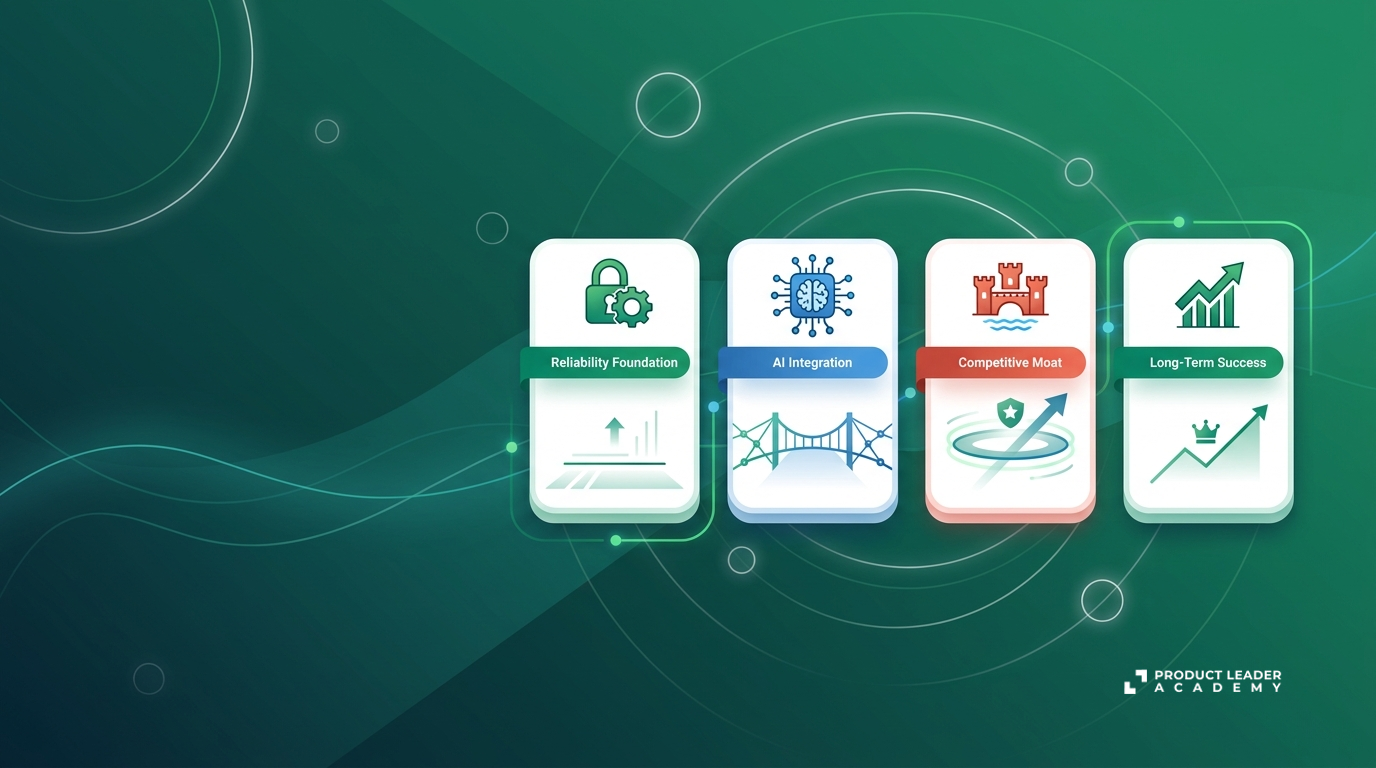
The Trust-First AI Strategy: Why Reliability is Your New Competitive Moat
In November 2022, the world entered the "Magic Phase" of Generative AI. Product Managers across the globe raced to integrate LLMs, dazzled by the ability to generate prose, code, and images from a single prompt. For a brief window, "having AI" was enough to satisfy stakeholders and intrigue users.
That window has slammed shut.
We have officially entered the Skepticism Phase. Users—both B2C and B2B—have been burned by hallucinations, privacy scandals, and "AI features" that add more work than they save. In the enterprise world, this has led to a phenomenon known as "Pilot Purgatory," where AI initiatives stall indefinitely because security and legal teams don’t trust the output.
The hard truth for product leaders is this: AI models are becoming a commodity. Whether you use GPT-4, Claude, or a fine-tuned Llama-3, the underlying intelligence is accessible to everyone. In this landscape, your competitive moat isn't the model you use; it’s the Trust you build around it.
A Trust-First AI Strategy is no longer a "nice-to-have" ethical consideration. It is a business imperative that drives retention, increases Lifetime Value (LTV), and shortens enterprise sales cycles. This article provides a framework for shifting your product philosophy from "Can we build it?" to "Should they trust it?"
1. The Three Pillars of the Trust-First Framework
Trust is a fragile asset. In the mind of a user, trust is binary: once a system lies to them or leaks their data, the relationship is broken. However, in the product development lifecycle, trust is built incrementally across three distinct pillars.
Pillar 1: Technical Reliability (The "Accuracy" Pillar)
Most AI demos work 80% of the time. The "Trust Gap" lives in the remaining 20%. Technical reliability is about solving the "long tail" of non-deterministic edge cases. It involves moving beyond generic prompts to robust architectures that handle ambiguity without making things up.
Pillar 2: Data Sovereignty & Privacy (The "Safety" Pillar)
Users are increasingly anxious about the "Data Black Box." They want to know: Is my proprietary data being used to train your next model? Who can see my prompts? Solving this pillar requires moving beyond legal compliance toward radical transparency.
Pillar 3: Psychological Transparency (The "UX" Pillar)
Even a 100% accurate AI can feel untrustworthy if the user doesn’t understand how it reached a conclusion. Psychological transparency is about bridging the gap between the AI’s hidden logic and the user’s mental model.
Key Insight: Trust is binary in the mind of the user but incremental in the build process. One hallucination can reset months of progress. As a PM, you must treat "Trust Debt" with the same urgency as technical debt.
2. Designing for Explainability: The UX of Trust
The "Black Box" is the enemy of adoption. When a user receives an answer from an AI and has no way to verify it, they are forced to choose between blind faith or total rejection. Most professional users will choose the latter.
To build trust, we must move toward Explainable AI (XAI) through intentional UX patterns.
The "Show Your Work" Pattern
Never present an AI output as an undisputed fact. Instead, provide the breadcrumbs.
- Citations: If your AI summarizes a document, provide clickable links to the specific paragraphs it used.
- Confidence Scores: If the model is only 60% sure of an answer, tell the user. "I'm fairly confident, but you might want to double-check this section" is a much more "human" and trustworthy response than a confident lie.
- Chain-of-Thought (CoT) Reasoning: For complex tasks, show the steps the AI took. "First, I analyzed your Q3 earnings; then, I compared them to industry benchmarks..."
Human-in-the-Loop (HITL) by Design
We need to shift our thinking from "Autopilots" to "Checkpoints." In high-stakes environments (Legal, FinTech, MedTech), the AI should be the drafter, and the human should be the editor.
- The "Approve" Button: Give users the final agency. The AI suggests; the human confirms. This maintains the user’s sense of responsibility and control.
Managing Expectations with Low-Fidelity UI
If an output is non-deterministic or a "best guess," don't use high-fidelity, "final" UI styling.
- Example: Use "Draft" watermarks, placeholder-style text, or distinct colors for AI-generated content. This signals to the user’s brain that the information is a suggestion, not a hard-coded fact.
3. Data Integrity & Ethics: The Foundation of Consent
For many enterprise customers, "AI" is synonymous with "Data Leak." To bridge the trust gap, product leaders must go beyond GDPR and SOC2 compliance.
The Zero-Retention Option
One of the most effective ways to win over enterprise clients is the Zero-Retention Tier. By offering a premium version where data is never stored and never used for training (utilizing APIs with strict data-use policies), you remove the primary barrier to adoption. This turns privacy into a revenue-generating feature.
Source Provenance and "Data Nutrition Labels"
Users need to know where the "knowledge" is coming from.
- Internal RAG vs. Public Knowledge: Clearly distinguish between an answer derived from the company’s own secure knowledge base (Retrieval-Augmented Generation) and an answer derived from the LLM’s general training data.
- The Nutrition Label: Create a visual component in your settings or onboarding that explains:
- Input: What data we collect.
- Processing: How the AI uses it.
- Storage: Where it lives and for how long.
- Training: Whether it contributes to model improvement.
Mitigating Bias as a Trust Metric
Bias isn't just a social issue; it's a brand risk. Biased outputs destroy user trust and brand equity. PMs should treat "Fairness" as a core KPI. Regular audits for representative outputs should be part of the Definition of Done for any AI feature.
4. Reliability Engineering for Product Managers
In traditional software, a bug is a binary failure of code. In AI, a "bug" is often a probabilistic failure of logic. This requires a new approach to reliability.
The Hallucination Tax
Every error an AI makes carries a "tax"—the time the user spends correcting it and the loss of confidence in the system. As a PM, you must calculate the ROI of trust.
- In Creative Writing, a 10% hallucination rate might be acceptable (it’s "creative").
- In Medical Coding, a 1% hallucination rate is catastrophic. Determine your "Acceptable Hallucination Rate" before you ship.
The Cost of Trust: Self-Correction Loops
One way to increase reliability is to use "LLM-as-a-judge." This involves running a second AI process to check the first one's work. While this increases latency and compute costs, the trade-off is often worth it for the boost in reliability.
Setting "Trust SLAs"
We are used to Service Level Agreements for uptime (99.9%). It’s time to start defining Trust SLAs for:
- Accuracy: What percentage of outputs are verified as correct?
- Grounding: What percentage of answers are backed by a source?
- Safety: What is the rate of "refusals" or inappropriate content?
Feedback Loops as Trust Builders
The "Thumbs Up/Down" button is more than just a data collection tool; it’s a psychological tool. When a user provides feedback and sees the system acknowledge it, they feel they are part of a learning process rather than victims of a static, broken machine.
5. Operationalizing Trust: Prioritization & Roadmap Changes
How do you turn these principles into a roadmap? It starts with changing how you prioritize.
The Trust-to-Value Matrix
When deciding which AI features to build, map them on a 2x2 matrix:
- Value of Automation: How much time does this save?
- Risk of Error: How bad is it if the AI is wrong?
- Low Risk / High Value: (e.g., summarizing internal meeting notes) — Automate fully.
- High Risk / High Value: (e.g., diagnosing a technical failure) — Human-in-the-loop only.
- High Risk / Low Value: — Avoid entirely.
Slowing Down to Speed Up
Integrate Red Teaming and Bias Audits into your sprint cycles. Red teaming involves intentionally trying to break the AI or make it produce harmful content. It feels like it slows down development, but it prevents the "PR fires" that can derail a product's reputation for years.
New KPIs for the AI Era
Standard metrics like "Daily Active Users" (DAU) don't tell the whole story for AI. Consider these "Trust KPIs":
- Correction Rate: How often do users manually edit the AI’s output? (Lower is better).
- Implicit Trust (Time to Accept): How long does it take for a user to click "Accept" or "Send" after an AI suggestion is generated?
- Source Click-Through Rate: In RAG systems, how often do users click the citations to verify the info? (High CTR initially is good; over time, a decline may signal growing trust).
Conclusion: The Long Game of AI Leadership
The "Move Fast and Break Things" era of software is ill-suited for the age of Artificial Intelligence. When you break things with AI, you don't just break code—you break the user's perception of reality and their trust in your brand.
The next generation of market leaders won't be the companies with the fastest inference speeds or the largest parameter counts. They will be the companies that moved from "Move Fast and Break Things" to "Move Fast and Prove Things."
By adopting a Trust-First Strategy, you are building a moat that is incredibly difficult for competitors to replicate. You are building a product that doesn't just work—it's a product that users can rely on.
Your Challenge: Audit your current AI roadmap this week. Identify the one feature where a hallucination would most damage user trust. Build a guardrail, a citation, or a human-in-the-loop checkpoint for it today.
In the AI race, the most reliable runner—not the fastest—will win the marathon.
Key Takeaways for the Reader
- Trust is a Feature: It must be designed, engineered, and measured with the same rigor as latency or UI.
- Explainability is the Antidote: Use citations, confidence scores, and reasoning steps to eliminate the "Black Box" effect.
- Privacy is a Premium: Features like zero-retention and data provenance are massive differentiators in the enterprise market.
- Measure the "Oops": Track Correction Rates and Implicit Trust to understand how users actually feel about your AI.
- Mental Models Matter: Success isn't just about the code being right; it's about the user knowing why it's right.
Tags
Related Articles
The Orchestrator PM: Leading Product in the Age of Agentic AI
Discover how agentic AI is redefining product management. Shift from administrative ticket writing to orchestrating autonomous agents for strategic leverage.
The AI-Augmented PM: Eliminating Ops Debt and Scaling Strategic Impact
Discover how AI-augmented PMs eliminate product ops debt, automate feedback synthesis, and reclaim their calendars to scale their strategic product impact.

Designing for Trust: The PM’s Guide to Trust-First AI UX
Transition from deterministic to probabilistic software with this PM guide to trust-first AI UX. Learn to manage AI failures and build user trust.