The 2-Hour AI Dividend: Navigating the Unwritten Rules of Product Management
AI is giving product managers a 2-hour dividend. Learn how to navigate the productivity paradox, avoid shadow AI, and turn saved time into real product value.

Product Leader Academy
PM Education
The 2-Hour AI Dividend: Navigating the Unwritten Rules of Product Management
It is 3:00 PM on a Tuesday. Sarah, a Senior Product Manager at a mid-sized SaaS company, has just finished a comprehensive PRD for a new API integration, a detailed competitive analysis of three emerging rivals, and summarized the key takeaways from six hours of recorded user interviews.
Normally, this workload would have kept her at her desk until 7:00 PM, fueled by lukewarm coffee and the looming dread of a missed deadline. Instead, she’s done. She has saved two hours. But as she stares at her completed dashboard, a strange sensation washes over her: productivity guilt. Is the work too easy now? If she submits these documents immediately, will her leadership think she’s cutting corners? Or worse, will they realize that a large portion of her "strategic" output was facilitated by an LLM?
Sarah is experiencing the Productivity Paradox. Recent data from McKinsey and the Nielsen Norman Group suggests that AI-augmented knowledge workers are seeing productivity gains of 20% to 30%. For the average PM, that is a "dividend" of roughly two hours per day.
The problem? Tools are moving faster than culture. While individual PMs are becoming hyper-efficient, organizational standards remain stuck in the pre-generative era. This has created a "Shadow AI" environment where PMs use these tools in secret, unsure of the unwritten rules, while leaders wonder why their teams are producing more documents but not necessarily better products.
To turn "time saved" into "value created," product leaders must move beyond accidental productivity and establish a formal AI Playbook.
2. Where the 120 Minutes Go: The High-Yield PM Tasks
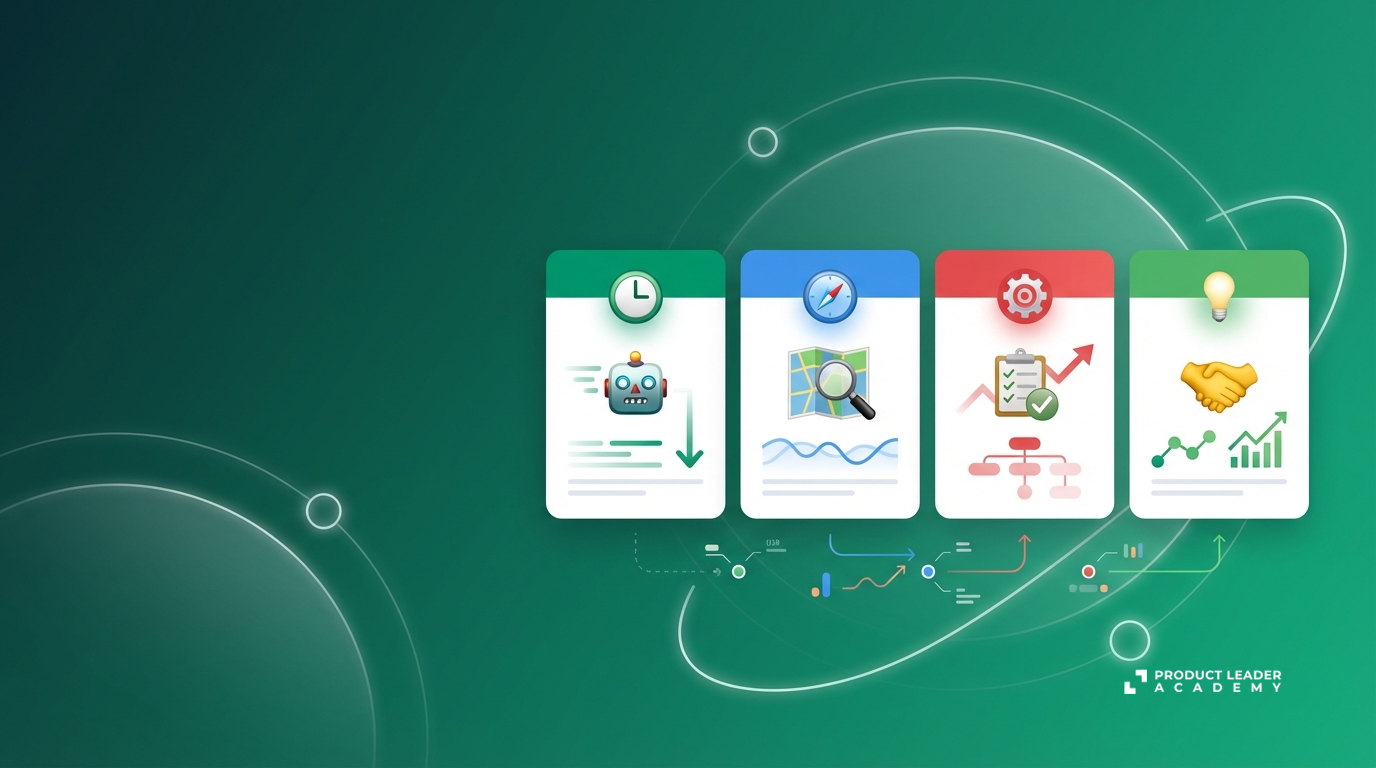
The "AI Dividend" isn't magic; it’s the result of offloading high-friction, low-leverage tasks. For the modern PM, the two-hour gain usually comes from three specific buckets.
Subsection: Killing the Cold Start
The hardest part of any product task is the blank page. Generative AI has effectively eliminated the "cold start" problem.
- PRDs and User Stories: By feeding an LLM a rough set of feature requirements and a customer persona, a PM can generate a 70% complete PRD in seconds.
- GTM Shells: AI can draft the first version of release notes, internal FAQs, and marketing copy based on the technical specs.
- The Gain: 45 minutes saved by moving directly to the editing phase rather than the drafting phase.
Subsection: Synthetic Synthesis
Product managers are drowning in qualitative data. Between Gong calls, Slack threads, and Zendesk tickets, the signal is often lost in the noise.
- The AI Lever: PMs are now using AI to ingest transcripts of ten customer interviews and extract the top three recurring pain points, complete with verbatim quotes.
- The Gain: 45 minutes saved on manual tagging and synthesis of research.
Subsection: The Administrative Subsidy
We often call this "work about work." It’s the Jira hygiene, the status updates, and the stakeholder comms that eat into deep work time.
- The AI Lever: Automating the transformation of a messy brainstorm into a structured project plan or summarizing a chaotic 50-comment Slack thread into an actionable "Next Steps" email.
- The Gain: 30 minutes saved on administrative overhead.
Key Point: It is vital to distinguish between shallow work (formatting, summarizing, and drafting) and deep work (strategy, empathy, and ethical trade-offs). AI handles the shallow; the PM must own the deep.
3. The "Unwritten Rules" and the Risks of Shadow AI
When there is no official playbook, PMs make their own rules. This leads to "Shadow AI," which introduces four significant risks to a product organization.
Subsection: The Hallucination Trap
AI is a "probabilistic" engine, not a "deterministic" one. It predicts the next most likely word, which makes it a very confident liar.
- The Risk: A PM asks an AI for market sizing data or technical constraints for a new feature. The AI provides a beautifully formatted table with plausible-looking numbers. If the PM doesn't verify this against a "ground truth," they may build a roadmap on a foundation of hallucinations.
Subsection: The Privacy Grey Zone
This is the single biggest concern for legal and security teams.
- The Risk: A PM, in an effort to be efficient, pastes a proprietary roadmap or sensitive customer PII (Personally Identifiable Information) into a public LLM to "summarize the risks." Without realizing it, they may be training public models on their company’s competitive advantages or violating GDPR/SOC2 compliance.
Subsection: The "Mid-Tier" Trap
If every PM uses the same prompts and accepts the first output, product thinking becomes commoditized.
- The Risk: "Lazy PMing." When we accept the AI’s first suggestion for a feature set, we get a "vanilla" product. AI optimizes for the average of the internet's training data. Great products, however, come from the outliers—the insights that AI can't see because they haven't been written down yet.
Subsection: Documentation Inflation
Just because AI can write a 20-page spec in thirty seconds doesn't mean your Engineering team wants to read it.
- The Risk: We are seeing a surge in "noise over signal." AI makes it easy to produce massive amounts of documentation, leading to "TL;DR" syndrome among developers. A 20-page PRD that used to take a week to write now takes ten minutes—but it still takes the engineer two hours to digest. This creates a bottleneck, not a benefit.
4. Establishing the AI Playbook: Frameworks for Leaders
Product leaders cannot ignore AI, nor can they simply "ban" it. They must provide a framework that legitimizes its use while safeguarding quality.
Subsection: The "Human-in-the-Loop" Mandate
Leaders must define "No-Fly Zones" versus "Auto-Pilot Zones."
- No-Fly Zones: Final prioritization, ethical trade-offs, team conflict resolution, and "kill/keep" decisions on major features. These require human accountability.
- Auto-Pilot Zones: First drafts of stories, summarizing meetings, and generating test cases.
Subsection: Transparency & The AI-Label
One of the biggest "unwritten rules" is whether a PM should disclose AI usage.
- The Standard: Move the team from a "Proof of Work" standard (I spent 10 hours on this) to a "Proof of Review" standard (I am 100% accountable for every word in this document, regardless of how it was generated).
- Actionable Advice: Encourage PMs to include a small "AI-Assisted" footer in documents, noting which parts were generated and which were verified. This builds a culture of honesty rather than one of "secret shortcuts."
Subsection: The Collaborative Contract
AI-augmented PMs move at 2x speed, but Design and Engineering often still move at "human" speed (for good reason).
- The Friction: If a PM drops five new PRDs on a team in one week because AI made it easy, they will break the sprint cycle and frustrate their peers.
- The Rule: AI speed must be used to increase quality and clarity, not just volume.
Subsection: Measuring the Dividend
Stop measuring "Output" (number of docs, number of stories). Start measuring "Outcomes."
- The Shift: If a PM is using AI, they should have more time to find "The Big Insight." Are the features we are building actually moving the needle? Is the speed to pivot increasing?
5. Reinvesting the "AI Dividend": From Output to Outcome
If a PM saves two hours a day, and they use that time to watch Netflix or just "do more admin," the company has gained nothing. The "AI Dividend" must be intentionally reinvested into high-leverage activities.
Subsection: Scaling Customer Empathy
AI can summarize a transcript, but it cannot see the frustration in a user’s eyes or the "workaround" they’ve taped to their monitor.
- Reinvestment: Use the saved 2 hours for unscripted, deep-dive customer interviews. Get out of the building (or the Zoom room) and observe the "jobs to be done" in the real world.
Subsection: Deep Strategy & White-Spacing
Most PMs are so caught up in the "feature factory" that they never look at the 12–24 month horizon.
- Reinvestment: Dedicate the dividend to "White-Spacing"—looking at market shifts, emerging technologies, and competitive moats that require deep, uninterrupted thought.
Subsection: High-Bandwidth Relationships
Product management is a game of influence without authority. Influence is built through trust, and trust is built through time.
- Reinvestment: Use the time to have "non-transactional" coffee chats with your Lead Engineer or Head of Sales. Understand their pressures and goals. This "social capital" is what gets features shipped when things go wrong.
Subsection: The Retention Play
Burnout is the silent killer of product teams. The "drudgery" of the role—the endless Jira tickets and status reporting—is often what drives talented PMs away.
- Reinvestment: Allow the AI dividend to act as a pressure valve. If a PM can do their work in 6 hours instead of 9, let them use that time for professional development or simply to achieve a sustainable work-life balance. A well-rested PM makes better strategic decisions.
6. The Future PM Skillset: Curation over Creation
The role of the PM is shifting from being the primary writer to being the primary validator.
Subsection: Prompting as Briefing
The ability to write a high-quality prompt for an AI is essentially the same skill as writing a high-quality brief for a developer. It requires:
- Context: Why are we doing this?
- Constraints: What are the boundaries?
- Objective: What does "done" look like? If a PM cannot prompt an AI, they likely cannot lead a human team effectively.
Subsection: The PM as Editor-in-Chief
In a world of AI-generated noise, the PM's value is their "taste." Like an Editor-in-Chief at a magazine, the PM doesn't write every article, but they decide which ones are "on-brand," which ones are "factually sound," and which ones are "ready for the world."
Subsection: Maintaining "Product Sense"
AI is excellent at predicting patterns based on the past. It is terrible at predicting "delight." Product sense—the intuitive understanding of what will resonate with a human being—is the ultimate moat. PMs must double down on their understanding of psychology, design, and human emotion.
7. Conclusion: Leading Through the Transition
The "2-Hour AI Dividend" is a gift, but it is a "use it or lose it" resource. If product leaders don't provide a framework for how to spend this time, it will be swallowed by documentation inflation, shadow AI risks, or simple inertia.
Call to Action for PMs:
Audit your 2 hours. For one week, track the time you save using AI. Be honest: Are you using that time to hide behind the tool, or are you using it as a lever to get closer to your customers and your strategy?
Call to Action for Leaders:
Draft your team’s AI principles today. Don't wait for HR or the Legal department to hand down a policy from on high. Define what "good" looks like for your team. Set the standard for transparency, verification, and reinvestment.
The unwritten rules of AI in product management are currently being lived every day in the "shadows." By bringing them into the light, we ensure that productivity leads to better products, not just faster failures. The rules aren't written yet—which means you have the unique opportunity to write them.
Tags
Related Articles
The Orchestrator PM: Leading Product in the Age of Agentic AI
Discover how agentic AI is redefining product management. Shift from administrative ticket writing to orchestrating autonomous agents for strategic leverage.
The AI-Augmented PM: Eliminating Ops Debt and Scaling Strategic Impact
Discover how AI-augmented PMs eliminate product ops debt, automate feedback synthesis, and reclaim their calendars to scale their strategic product impact.
Designing for Trust: The PM’s Guide to Trust-First AI UX
Transition from deterministic to probabilistic software with this PM guide to trust-first AI UX. Learn to manage AI failures and build user trust.