Bridging the Gap: Mastering UX and Dev Collaboration via the Double Diamond
Learn how Product Managers can use the Double Diamond framework to synchronize UX and Engineering teams for faster, higher-quality product delivery.
Product Leader Academy
PM Education
Introduction: The Collaboration Crisis
In many product organizations, a familiar and frustrating pattern emerges. The design team spends weeks conducting user research and crafting a pixel-perfect interface. They 'hand it over' to the engineering team, only to be met with a collective sigh. 'This will take six months to build,' says the Lead Engineer. 'We don't have the infrastructure for this animation,' says another.
The result? Compromised features, delayed timelines, and a palpable tension between UX and Development. This friction isn't just a cultural issue; it's a process failure. To build world-class products, we must move away from the 'relay race' model and toward a 'tandem bicycle' approach.
The Double Diamond framework, popularized by the British Design Council, is often viewed strictly as a design methodology. However, for Product Managers (PMs) and Product Leaders, it is the ultimate tool for cross-functional synchronization. When applied correctly, it doesn't just improve design; it aligns technical feasibility with user desirability from day one.
Understanding the Double Diamond (Beyond Design)
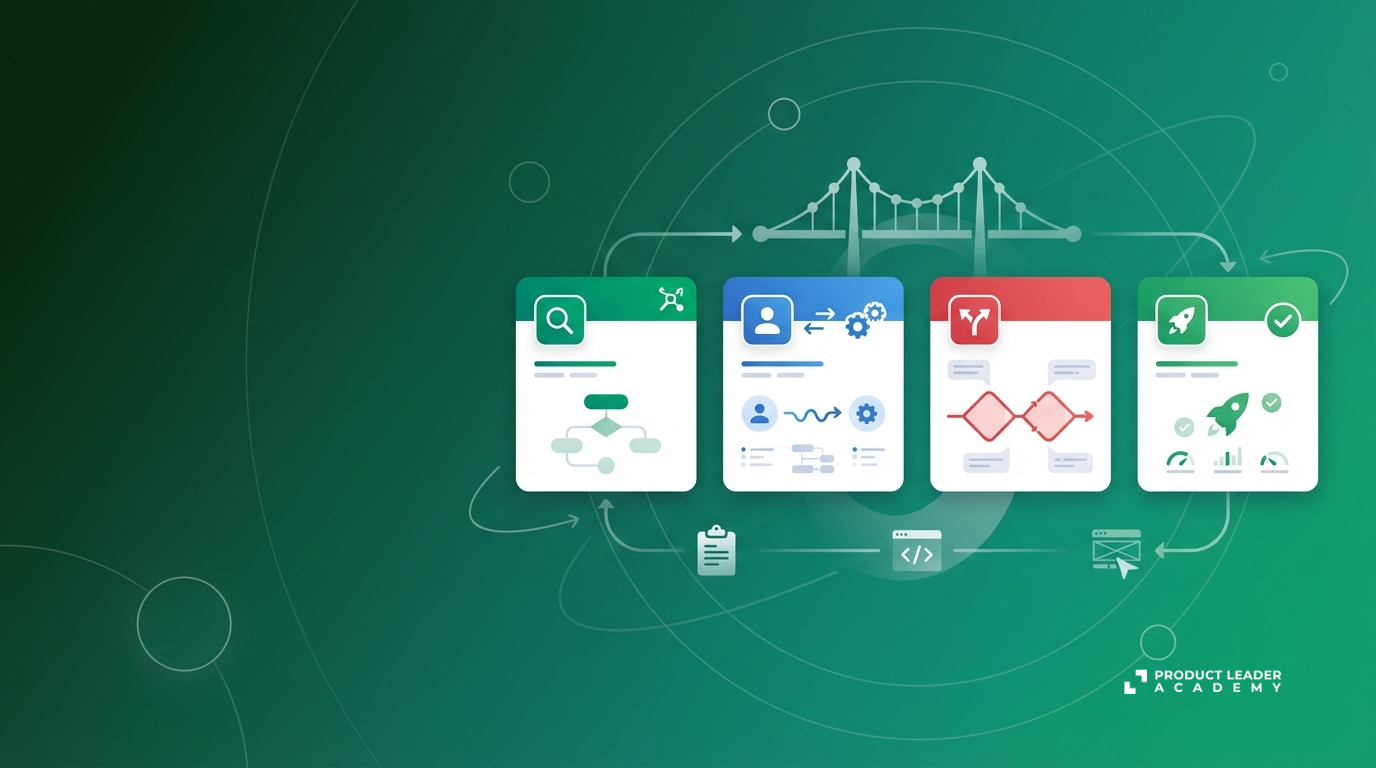
To bridge the gap, we must first redefine what the Double Diamond is. It consists of four distinct phases:
- Discover: Divergent thinking to understand the problem space.
- Define: Convergent thinking to narrow down the specific challenge to solve.
- Develop: Divergent thinking to explore potential solutions.
- Deliver: Convergent thinking to build and launch the final product.
The common mistake is assuming UX 'owns' the first diamond (Discover/Define) and Development 'owns' the second (Develop/Deliver). In a high-performing product team, both disciplines must be active participants in all four phases.
The Silo Trap: Why Linear Handoffs Fail
When UX and Dev operate in silos, the cost to the business is astronomical. We see three primary failure modes:
- The Feasibility Wall: Designers create solutions that are technically impossible or prohibitively expensive within the current tech stack.
- The Context Gap: Developers don't understand the 'why' behind a feature, leading to technical decisions that inadvertently undermine the user experience.
- The Re-Work Loop: Features go back and forth between design and dev for weeks because basic constraints weren't discussed early on.
By integrating these teams through the Double Diamond, we turn 'handoffs' into 'continuums.'
Phase 1: Collaborative Discovery (The First Diamond)
Discovery is often seen as the exclusive domain of UX researchers and PMs. However, excluding engineers from this phase is a missed opportunity for innovation.
Involving Engineering in User Research
Product Leaders should encourage 'Technical Discovery' alongside 'User Discovery.' When a developer sits in on a user interview, they don't just see a user struggling with a button; they see a data architecture problem or a latency issue that a designer might miss.
Actionable Advice:
- The 1-Hour Rule: Require lead engineers to spend at least one hour per sprint observing user testing or reading research synthesis.
- Technical Spikes: While UX explores user needs, Dev should conduct 'spikes' to explore the feasibility of potential technologies that could solve those needs.
Phase 2: Shared Definition (The Pivot)
The point where the first diamond closes is the most critical moment for collaboration. This is where the team decides exactly what problem they are going to solve.
The 'Three Amigos' Session
Adopt the 'Three Amigos' approach: a PM, a Designer, and a Lead Developer must agree on the problem statement. If the developer feels the problem is ill-defined or the scope is technically risky, the team doesn't move to the next diamond.
Real-World Example: A fintech startup wanted to 'simplify the onboarding process.' UX wanted a multi-step, interactive guide. Engineering pointed out that the legacy API for identity verification took 30 seconds to respond. By defining the problem together, they realized the real challenge wasn't the UI—it was managing the user's perception of wait time. They pivoted to a 'background verification' model that allowed users to explore the app while their ID was being processed.
Phase 3: Integrated Development (The Second Diamond)
As we move into the 'Develop' phase—exploring solutions—the collaboration should intensify. This is where 'Design Systems' become the common language.
Design Systems as a Bridge
A robust design system is not just a Figma library; it is a shared set of components in code. When UX and Dev use the same vocabulary (e.g., 'Primary Button,' 'Modal-Large'), the friction of implementation vanishes.
Actionable Advice:
- Co-Design Workshops: Have designers and developers sketch solutions together on a whiteboard (or digital equivalent). This prevents the 'I didn't know you were going to build it like that' conversation later.
- Prototyping in Code: For complex interactions, skip the high-fidelity Figma prototype and have a developer build a 'quick and dirty' functional prototype. This clarifies feasibility instantly.
Phase 4: Unified Delivery (The Final Stretch)
The final phase is about narrowing down to the best solution and shipping it. Collaboration here focuses on quality and iteration.
The 'Dev-Design Pairing' for QA
Traditional QA often focuses on bugs. 'Design QA' focuses on the experience. Instead of the designer sending a list of 50 UI bugs to the developer, have them sit together for two hours to live-tweak the CSS and interactions. This builds empathy and speeds up the 'polish' phase by 3x.
The Product Leader’s Playbook: Strategies for Success
As a Product Leader, your job is to create the environment where this collaboration can thrive. Here are four strategies to implement today:
1. Shared KPIs
If UX is measured on 'Usability Scores' and Dev is measured on 'Velocity,' they will naturally clash. Instead, give them shared goals, such as 'Time to Value' or 'Feature Adoption Rate.' When they win or lose together, they collaborate better.
2. Overlapping Roadmaps
Ensure your roadmap includes 'Technical Debt' and 'Design Debt' alongside new features. This shows both teams that their specific concerns are valued and integrated into the product strategy.
3. The 'Design-to-Dev' Ratio
Monitor your ratios. If you have one designer for 20 developers, collaboration is impossible; the designer becomes a 'wireframe factory.' Aim for a healthier ratio (typically 1:6 or 1:8) to allow designers the time to actually participate in the engineering process.
4. Foster 'T-Shaped' Skills
Encourage designers to learn the basics of React or CSS. Encourage developers to learn the basics of information architecture and user psychology. You don't need them to do each other's jobs, but you do need them to speak each other's languages.
Real-World Example: The 'Checkout Overhaul'
A major e-commerce PM noticed high cart abandonment.
- Discover: UX did interviews; Dev analyzed database logs. They found that users were confused by shipping options, and the database was timing out during address validation.
- Define: They defined the goal: 'Reduce checkout time by 40% while ensuring 99.9% database uptime.'
- Develop: Designers sketched a single-page checkout. Developers suggested using a third-party address validation API to reduce server load.
- Deliver: They paired on the implementation, using a shared component library.
The result? A 15% increase in conversion and zero post-launch technical emergencies.
Conclusion: Building a Culture of Co-Creation
The Double Diamond is more than a diagram; it is a commitment to shared ownership. When Product Managers facilitate deep collaboration between UX and Development across all four phases, the 'handoff' disappears. What remains is a unified team that understands the user's pain, respects the technical constraints, and takes pride in the final solution.
Product excellence is not found in the perfect design or the cleanest code—it is found in the intersection of the two. Start by inviting a developer to your next research session, and watch the diamond begin to shine.