Opportunity Scoring: Finding Your Biggest Product Wins
Discover how to use Opportunity Scoring to identify high-value product improvements by measuring importance vs. satisfaction gaps.

Product Leader Academy
PM Education
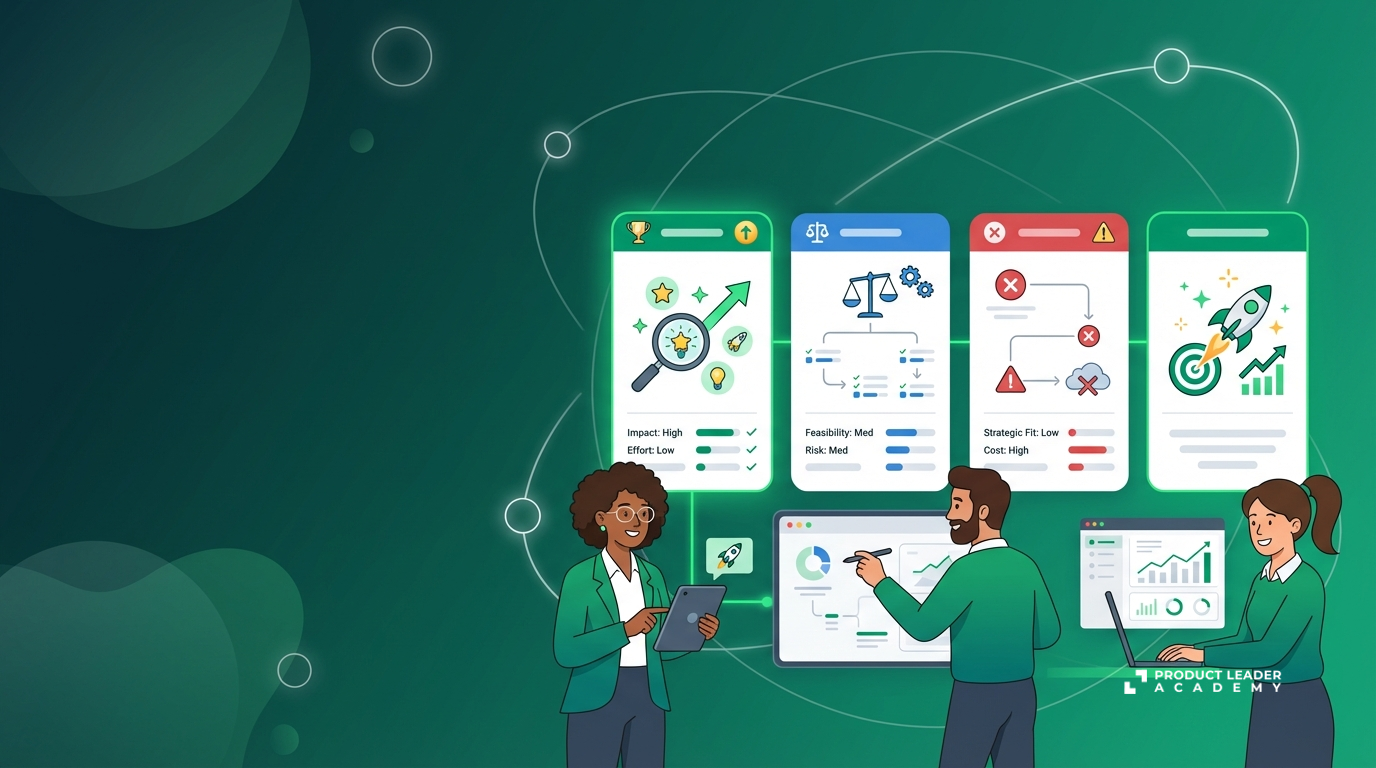
What is Opportunity Scoring?
Opportunity Scoring is a customer-centric prioritization method developed by Anthony Ulwick as part of his Outcome-Driven Innovation (ODI) framework. It identifies where customers are most underserved by measuring the gap between how important a need is and how satisfied customers are with current solutions.
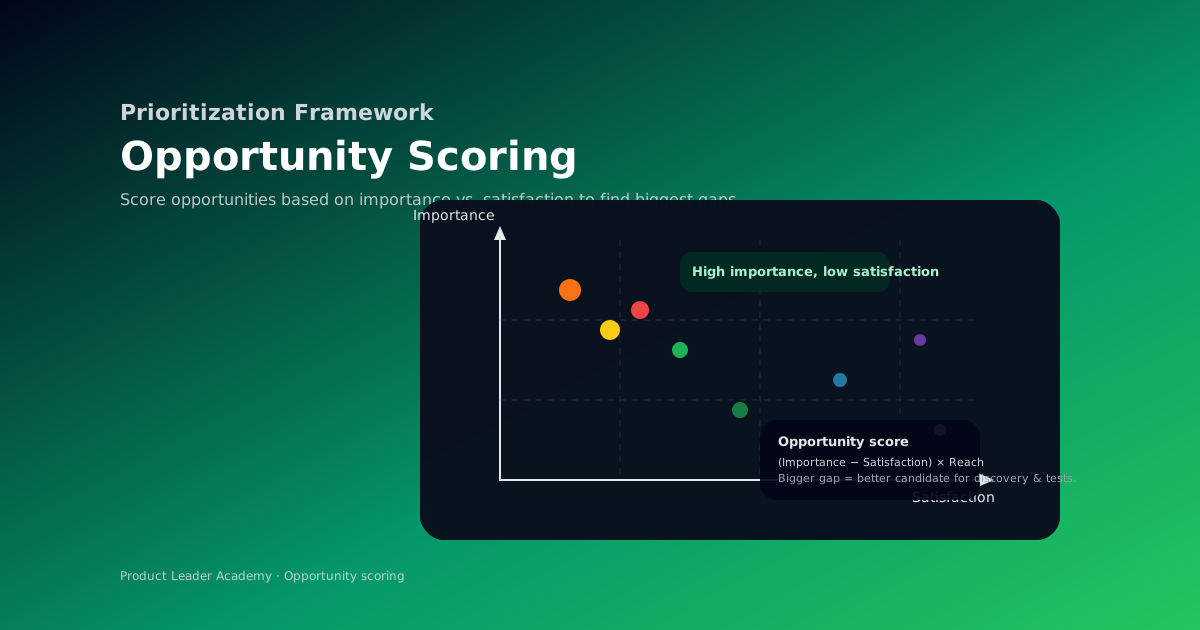
The core insight: the biggest product opportunities exist where importance is high but satisfaction is low.
The Opportunity Score Formula
Opportunity Score = Importance + max(Importance - Satisfaction, 0)
Where:
- Importance is rated 1-10 by customers
- Satisfaction is rated 1-10 by customers
- The score ranges from 1 to 20
Interpreting Scores
| Score Range | Interpretation | Action |
|---|---|---|
| 15-20 | Extremely underserved | Immediate opportunity |
| 12-14.9 | Significantly underserved | High priority |
| 10-11.9 | Moderately underserved | Worth exploring |
| Below 10 | Adequately served or overserved | Lower priority |
Why Opportunity Scoring Works
1. Customer-Grounded Decisions
Unlike internal scoring methods, Opportunity Scoring starts with what customers actually need and how well those needs are met today.
2. Identifies Hidden Gaps
Teams often focus on the loudest feedback. Opportunity Scoring systematically uncovers gaps that customers may not explicitly complain about but deeply feel.
3. Reduces Bias
By quantifying importance and satisfaction separately, the framework prevents teams from assuming they know what matters most.
4. Competitive Advantage
High opportunity scores reveal where competitors are failing—prime territory for differentiation.
How to Conduct Opportunity Scoring
Step 1: Define Customer Outcomes
List the outcomes customers are trying to achieve. Use the Jobs to Be Done format:
Minimize [undesired outcome] when [context] Maximize [desired outcome] when [context]
Examples for a project management tool:
- Minimize the time it takes to understand project status
- Minimize the effort required to reassign tasks
- Maximize visibility into team workload distribution
- Minimize the risk of missing deadlines
Tips:
- Aim for 15-30 outcomes per job
- Keep outcomes solution-agnostic
- Focus on measurable results, not features
Step 2: Survey Customers
For each outcome, ask two questions:
-
"How important is it to you that you can [outcome]?" Scale: 1 (Not important) to 10 (Extremely important)
-
"How satisfied are you with your current ability to [outcome]?" Scale: 1 (Not satisfied) to 10 (Extremely satisfied)
Sample size: Aim for 100+ responses for statistical reliability.
Step 3: Calculate Opportunity Scores
For each outcome:
Importance avg = mean of all importance responses
Satisfaction avg = mean of all satisfaction responses
Gap = Importance avg - Satisfaction avg
Opportunity Score = Importance avg + max(Gap, 0)
Step 4: Plot the Opportunity Landscape
Create a scatter plot:
- X-axis: Satisfaction (10 to 1, reversed)
- Y-axis: Importance (1 to 10)
This creates four quadrants:
| Quadrant | Importance | Satisfaction | Strategy |
|---|---|---|---|
| Underserved (top-left) | High | Low | Primary opportunity |
| Served Right (top-right) | High | High | Maintain/protect |
| Overserved (bottom-right) | Low | High | Reduce investment |
| Don't Care (bottom-left) | Low | Low | Ignore |
Step 5: Prioritize and Act
Rank outcomes by Opportunity Score. The highest-scoring outcomes represent your biggest product opportunities.
Real-World Example
Project: Improving an Email Marketing Platform
Customer outcomes surveyed (selected):
| Outcome | Importance | Satisfaction | Gap | Score |
|---|---|---|---|---|
| Minimize time to create a campaign | 9.2 | 4.1 | 5.1 | 14.3 |
| Maximize deliverability rate | 9.5 | 7.8 | 1.7 | 11.2 |
| Minimize time to segment audience | 8.8 | 3.9 | 4.9 | 13.7 |
| Maximize template flexibility | 7.1 | 6.5 | 0.6 | 7.7 |
| Minimize errors in personalization | 9.0 | 5.2 | 3.8 | 12.8 |
| Maximize A/B test insights | 8.3 | 4.0 | 4.3 | 12.6 |
Key insight: Campaign creation speed (14.3) and audience segmentation (13.7) are significantly underserved—bigger opportunities than template flexibility (7.7), which the team was planning to prioritize.
Opportunity Scoring vs Other Methods
| Aspect | Opportunity Scoring | RICE | Kano | MoSCoW |
|---|---|---|---|---|
| Data source | Customer survey | Internal estimates | Customer survey | Stakeholder input |
| Focus | Need gaps | Business impact | Satisfaction categories | Urgency |
| Quantitative | Yes | Yes | Partially | No |
| Identifies gaps | Yes | No | Partially | No |
| Best for | Feature strategy | Backlog ranking | Feature types | Sprint planning |
Best Practices
1. Be Specific with Outcomes
Vague outcomes like "easy to use" yield useless data. Be precise: "Minimize the number of clicks to complete [task]."
2. Survey the Right People
Target active users of the job you're studying, not just your product's users. Include competitor users and non-consumers.
3. Segment Results
Different user segments may have different importance and satisfaction ratings. Segment by persona, use case, or company size.
4. Combine with Feasibility
Opportunity Score tells you where to invest, not how much it costs. Pair with effort estimates before committing.
5. Revisit Quarterly
Satisfaction shifts as you ship improvements and competitors evolve. Re-survey to catch emerging opportunities.
Common Pitfalls
- Leading questions — Keep surveys neutral; don't hint at your product
- Too few outcomes — Under 10 outcomes misses important gaps
- Ignoring overserved areas — These are candidates for simplification or cost reduction
- Static analysis — Satisfaction changes; resurvey regularly
Template: Opportunity Scoring Project
Week 1: Preparation
- Define 15-25 customer outcomes using JTBD interviews
- Draft survey with importance + satisfaction scales
- Identify target respondents (100+)
Week 2: Data Collection
- Launch survey
- Send reminders at day 3 and day 5
- Close at 100+ responses
Week 3: Analysis
- Calculate scores for each outcome
- Create opportunity landscape plot
- Identify top 5 underserved outcomes
Week 4: Action
- Present findings to stakeholders
- Map top opportunities to potential features
- Feed into RICE or roadmap planning
Conclusion
Opportunity Scoring cuts through opinion-based prioritization by grounding decisions in what customers actually need and where they're currently underserved. The gap between importance and satisfaction is where your biggest product wins hide.
By systematically measuring these gaps, you can focus engineering effort where it creates the most customer value—and the strongest competitive advantage.
Ready to master customer-driven prioritization? Join Product Leader Academy for frameworks, tools, and hands-on practice.
Tags
Related Articles
Opportunity Scoring: Finding Your Biggest Product Wins
Discover how to use Opportunity Scoring to identify high-value product improvements by measuring importance vs. satisfaction gaps.
Lean Customer Discovery: How to Validate Ideas Faster and Build What Matters
Stop building features nobody wants. Learn how Lean Customer Discovery helps Product Managers validate ideas faster and avoid the Build Trap with less effort.

Defusing the HiPPO: Manage Executive Opinions Without Burning Bridges
Learn the Hypothesis Decoupling Protocol to translate executive demands into prioritized, testable product bets without damaging relationships.